Interested in progressing from experienced pilot to Hurricane pilot? Explore the Harvard-to-Hurricane training pathway and discuss your flying background with the team. This page explains the preparation involved, the experience expected and the questions to consider before pursuing solo flight in a historic Hawker Hurricane.
Enquire about Hurricane pilot training
Who is Hurricane training suitable for?
This pathway suits qualified pilots with substantial flying experience who want to progress towards solo Hawker Hurricane flying. The entry criteria previously published on this page are:
For initial training we require “Minimum 450 hours PIC, SEP rating, Class 2 medical. Significant tailwheel experience preferred (ideally 100+ hours tailwheel, 10+ hours solo on a heavy tailwheel type). Prior warbird or high-performance taildragger experience will be considered on a case by case basis.”
The stated minimum requirements are 450 hours as pilot in command (PIC), an SEP rating and a Class 2 medical. The tailwheel figures are preferences, not stated minimum requirements. Ask the team to confirm the current criteria and assess your background before making training plans.
The training pathway: Harvard to Hurricane
Harvard preparation is a step towards Hurricane conversion training. The programme described in the historical feature below includes further tailwheel, aerobatic or spin training where needed, followed by Harvard flying before progression to the Hurricane.
Read about Harvard conversion training, including tailwheel handling, energy management, cockpit management and emergency procedures. This warbird training develops relevant skills, but progression towards the Hurricane depends on the individual pilot’s experience and readiness.
The amount of preparation varies. The flying hours and personal accounts in the 2021 feature are historical examples, not a fixed course duration or a guarantee of solo flight. Confirm the training location and arrangements directly with the team.
Training costs and availability
The previously published programme information states:
Training is flown commercially in both the Harvard and the Hurricane, and represents a significant financial commitment. A minimum of five hours is required to secure a place on the Hurricane programme. Full costs are discussed individually with the Chief Pilot before training begins.
Ask the team for current costs, VAT treatment and availability. Confirm what the minimum five-hour commitment covers, which aircraft it applies to and how it relates to your individual training plan. This commitment does not promise completion of training or solo flight within five hours.
Flying after conversion
The 2021 feature describes an intention to let pilots continue flying V7497 after solo conversion and maintain currency. Confirm the current access, currency requirements, costs and conditions with the team before relying on that opportunity.
The story of Hurricane V7497
Historical feature: the people, preparation and aircraft behind the pathway. This page credits Ben Dunnell, Key.Aero, with the feature below, dated 2 September 2021. Its interview statements, approval and exclusivity claims, locations, ownership-share offer and references such as “now” or “currently” reflect the historical account; they do not confirm current course terms. Please enquire about current arrangements.
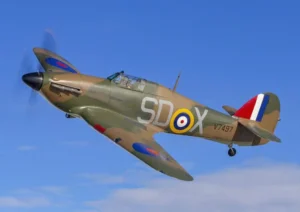 Historical feature extracted from Key.Aero. By Ben Dunnell |
Various companies will teach you to fly a Spitfire. But once you’ve gone solo, what then? The likelihood is that an owner isn’t about to hand you the keys. Hurricane 501 Operations has set out to bridge that gap between training on a warbird and gaining permission to fly one. The name references No 501 Squadron, with which Hawker Hurricane I V7497 flew during the Battle of Britain. And what makes the programme different is simple: having soloed on the Hurricane, newly trained pilots can go on flying her.
“Now, with V7497, there’s the opportunity to go further still, because we have the CAA’s permission to provide fully remunerated flight training on the Hurricane,” says Dr Peter Kirkpatrick, the aircraft’s majority owner. “As a result, the Hurricane is unique in that it will be the only one worldwide available for training and maintaining currency.”
The bigger question
With costs rising and airshow revenue diminishing, historic aircraft operations need new ways to stay viable and new pilots to fly them. “The unanswered question,” says John Thorogood (owner), “is, ‘When the present cadre of ageing warbird pilots have hung up their helmets, who is going to fly these aircraft?’ At some stage, we’ve got to get the new generation of young pilots flying them. How do we do that safely? Hopefully, operations like ours will open the way.”
The pathway: Harvard, Hurricane
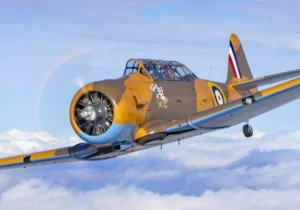 The training link is with T-6 Harvard Ltd, long established at Duxford, operating Canadian Car and Foundry-built Harvard IV G-BJST wartime RAF desert camouflage, and the name Wacky Wabbit. As things stand it is the only UK-based organisation offering solo flying after conversion onto type.
“It is much more straightforward to do with the Harvard, because it is operated on a certificate of airworthiness and therefore available for hire. It is the perfect training aircraft to move on to the Hurricane. “The guys who operate the aircraft are extremely experienced Harvard pilots,” says Kirkpatrick. “This makes for a relatively safe transition to the Hurricane. Very few people have that luxury.”
The programme targets qualified pilots with substantial experience already. Those needing further tailwheel, aerobatic or spin training get it in a Pitts S-2A Special — and one student is currently coming through the system from initial PPL upwards, taking in an aerobatic rating and the Harvard, with the Hurricane in view.
Harvard preparation and pilot readiness
 The amount of Harvard time a pilot needs before soloing the fighter varies considerably. As the chief pilot puts it: “I’ve had several experienced pilots who think they’ll just need a quick whiz-round in the Harvard. Seventeen or so hours later, they are ready to go solo!”
Mr Kirkpatrick (owner) is candid about why the step up is bigger than people assume. “There is an idea that if you can fly a Pitts you can fly anything. I don’t think that’s true. A Pitts, once you’ve got to grips with it, is a highly sympathetic aeroplane. That’s very different to warbirds, which don’t do what you tell them to do, particularly at low speed. They lose rudder authority, and on the ground it’s like trying to steer a heavy tanker with brakes that would barely stop a mountain bike. It’s a completely different discipline.”
From neurosurgery to Merlin power
Peter Kirkpatrick came to all this by an unusual route. An eminent neurosurgeon, he retired from the NHS this summer to focus on the aircraft — “to make the business side work, and obviously to fly her myself.”
His flying began with hang-gliding as a medical student, moved through flex-wing microlights and light aeroplanes, and took a significant step up in 2009 with his own Pitts S-2A Special. The Hurricane, via a good deal of Harvard time, followed a few years later. “I made contact with Tony Ditheridge at Hawker Restorations, which was about to be taken over by new owners,” he recalls. “I couldn’t afford to get into the project alone, so we ended up doing a shared deal.”
The business case mattered from the outset. “Most warbirds are owned by high net-worth individuals. In our case, we had to develop a viable business model. In addition, I am not one for seeing things stagnate. Having gone to the effort of building a flyable Hurricane, it needs to be flown. Nothing would give me more pleasure than to see her flown for 100 hours a year. The problem we face is that most able pilots can’t afford more than a few hours.”
“My heart sank”
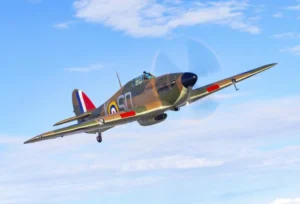 Kirkpatrick’s own path into the aircraft showed him exactly why pilots needed an affordable, structured route. When he first learned how much the necessary Harvard time would cost, “my heart sank.”
Chance intervened. “I happened to be at Hawker Restorations when I was told this, and there was a visiting American neurosurgeon there. He’d retired in his 50s, and he said, ‘Don’t worry about that, Kirk. I’ve got a Harvard in North Carolina. Please come over, all you need to do is put petrol in it.’
“So, I did. I spent two separate weeks out there and gathered about 25 hours, which taught me the mechanics of the aeroplane. But of course, in the States you have runways on which you could land a Shuttle, so you have all the time in the world to sort yourself out. Come to a busy place like Duxford, with a short downwind leg and three aircraft in the circuit, and it all becomes very different.”
When he met the team at the Aircraft Restoration Company, their verdict was blunt. “They immediately threw that experience into the bin and said I’d have to start again — and they were absolutely right. I did an additional 15 hours of Harvard flying here before I went solo in the Hurricane, so it took me about 40 hours altogether, but over quite a long period of time.” And there, he says, is the lesson at the heart of the programme: “In retrospect, if you can compress the training into two or three months rather than two or three years, it makes a considerable difference.”
“What was all the fuss about?”
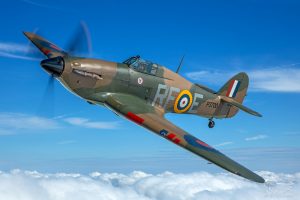 V7497’s third co-owner, John Thorogood, became the latest pilot to solo the Hurricane, on 13 August following his father. Sgt Pilot, later Sqn Ldr, Laurence Thorogood flew Hurricanes with No 87 Squadron in the Battle of Britain, claiming a Ju 88 destroyed and a Ju 87 damaged, and accumulated 550 Hurricane hours across England, India and the Arakan campaign in Burma. “My father died in 2006,” says John, “but he was often heard to mutter, ‘Don’t worry, John. You’ll fly a Hurricane one day.’ The problem with parents wishing these things on you is that they stick.”
He logged 38½ hours on the Harvard — and, being a bit of a geek, counted the landings: 119 “You don’t just jump into a Hurricane and fly her. It is wise to spend a good hour-and-a-bit taxiing her around the airfield… I vividly remember the first take-off, notable for the noise and heat from the radiator beneath my seat; a bit of a faff when operating the gear retraction for the first time, and being surprised by the force required to move the lever through the gate. Changing to the main tanks, reducing to climb power and departing the circuit, I had a minor panic about how on earth I was going to get her down in one piece.
“But the training asserted itself… Gear and flaps down at 120mph, harness locked and canopy locked open. Lined up on finals, good visibility over the nose, 85mph over the M11, 15kt wind straight down the runway, I rounded out and settled gently on three points. What was all the fuss about, I asked myself.”
V7497 shot down on her seventh sortie
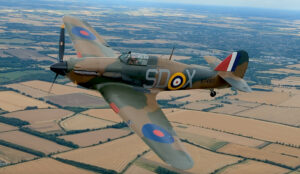 V7497 came from the Hawker factory in Langley, Berkshire, and joined No 501 Squadron at Kenley in September 1940. On only her seventh operational sortie, on 28 September, a Messerschmitt Bf 109 shot her down over Kent. Her pilot, Plt Off E. B. Rogers, bailed out successfully.
At the controls of the 109 was Oberlt Gustav Sprick, Staffelkapitän of 8./JG 26, who claimed 11 victories during the Battle of Britain. V7497 was his 20th overall, and brought him the Knight’s Cross, presented personally by Hitler. Some years ago, Peter Kirkpatrick was able to meet Sprick’s niece, through a German neurosurgeon friend.
Aviation archaeologists located the wreck near East Sutton in the 1990s. Hawker Restorations acquired the remains, registered the aircraft G-HRLI in 2002, and rebuilt her using numerous original items alongside new steel tubing and period-accurate fittings. Eye Tech Engineering overhauled the Merlin III. She flew again on 30 August 2018 from Elmsett, Suffolk, in the hands of type expert Stu Goldspink, and has been a fixture on the airshow circuit ever since.
Get involved
Hurricane 501 Operations is seeking pilots for the training programme, a new co-owner, and sponsorship to help meet V7497’s operating costs. A share in the aircraft is currently available.
“We would welcome any approaches from individuals who might be interested either from an active piloting point of view or as an investor,” says Peter Kirkpatrick.
Enquiries: [email protected]
Photography: Darren Harbar
Hurricane pilot training FAQs
What experience do I need before Hurricane training?
The published criteria above specify 450 hours PIC, an SEP rating and a Class 2 medical, with significant tailwheel experience preferred. The team considers prior warbird or high-performance taildragger experience case by case. Confirm the current entry requirements with the team.
How does Harvard training prepare a pilot for the Hurricane?
Harvard training develops tailwheel handling, energy management, cockpit management and emergency-procedure skills. The historical feature describes the Harvard as the preparation stage before progressing to the Hurricane.
How much training will I need?
Preparation varies considerably with the pilot. Discuss your experience with the team for an individual plan. The historical examples and five-hour commitment do not establish a fixed completion time or guarantee solo flight.
How do I enquire about costs and availability?
Email [email protected] with your flying background and training goals. Ask for current costs, VAT treatment, location, availability and clarification of the five-hour commitment.
What flying opportunities are available after conversion?
The historical feature describes continued flying and currency on V7497 after conversion. Current opportunities and their conditions need confirmation directly from the team.