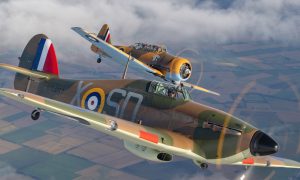
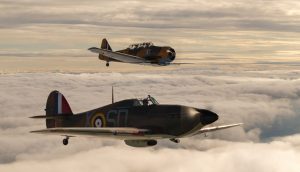
The closest you’ll ever get to the Battle of Britain.
This is the flight of a lifetime, with a Hurricane on your wing.
Just as it did during the war, the Hurricane will scramble from Duxford to meet you in the air. You’ll fly in the Harvard “Wacky Wabbit” for 10 to 20 unforgettable minutes, but this is no ordinary warbird experience. Around five minutes into your flight, that legendary Hawker Hurricane will slide alongside you, close enough to study every rivet, before peeling away and rolling gracefully over the top of your aircraft to show off its full silhouette from every angle.
We have all seen the Hurricane sitting still in a museum, quiet and grounded. Very few people ever get to see it doing what it was built to do: hunting the sky, wing to wing, alive with the same power and grace that defended Britain’s skies in 1940.
For those few minutes, you will not just be a passenger. You’ll be flying formation with history itself.
And this isn’t just a ride. Once you’re safely airborne and clear of the circuit, the controls become yours. You will take the stick of the Harvard and actually fly the machine yourself, feeling the same responsive handling that made it the RAF’s chosen advanced trainer for a generation of Spitfire and Hurricane pilots.
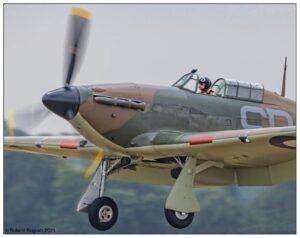 While you fly, the Hurricane keeping station on your wing carries a story most people never hear. Though the Spitfire took the glory and the headlines, it was the humble Hurricane that did the heavy lifting during the Battle of Britain. Tougher, more numerous, and easier to repair after battle damage, the Hurricane accounted for more enemy aircraft destroyed than every other form of British air defence combined, responsible for shooting down around 60% of all Luftwaffe losses during the battle. It was the unsung workhorse that held the line when Britain stood alone, and today, it is one of the rarest warbirds left flying anywhere in the world.
To take the controls of a Harvard, scrambled Hurricane at your wingtip just as it would have been in 1940, is not something you will find anywhere else. It’s a front row seat, and the pilot’s seat, in one of the most remarkable stories in aviation history.
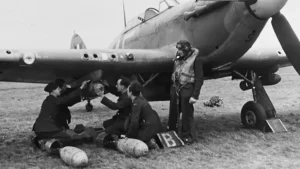 Designed by Sir Sydney Camm in the mid-1930s, this robust monoplane entered service in December 1937 and became the first RAF aircraft capable of flying over 300 mph. While it is frequently overshadowed by the more glamorous Supermarine Spitfire, the Hurricane was the backbone of Britain’s aerial defence during the nation’s darkest hours.
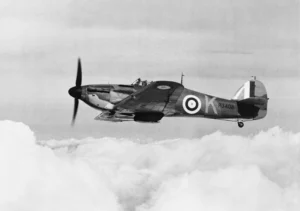 By the height of the Battle of Britain, Hurricanes outnumbered Spitfires in RAF Fighter Command by nearly two to one, and it was Hurricane squadrons that met the majority of incoming Luftwaffe bomber formations head on. Steady, hard hitting and available in far greater numbers, the Hurricane is credited with shooting down more enemy aircraft than any other type during the battle, quietly doing the work that ultimately kept Britain in the war.